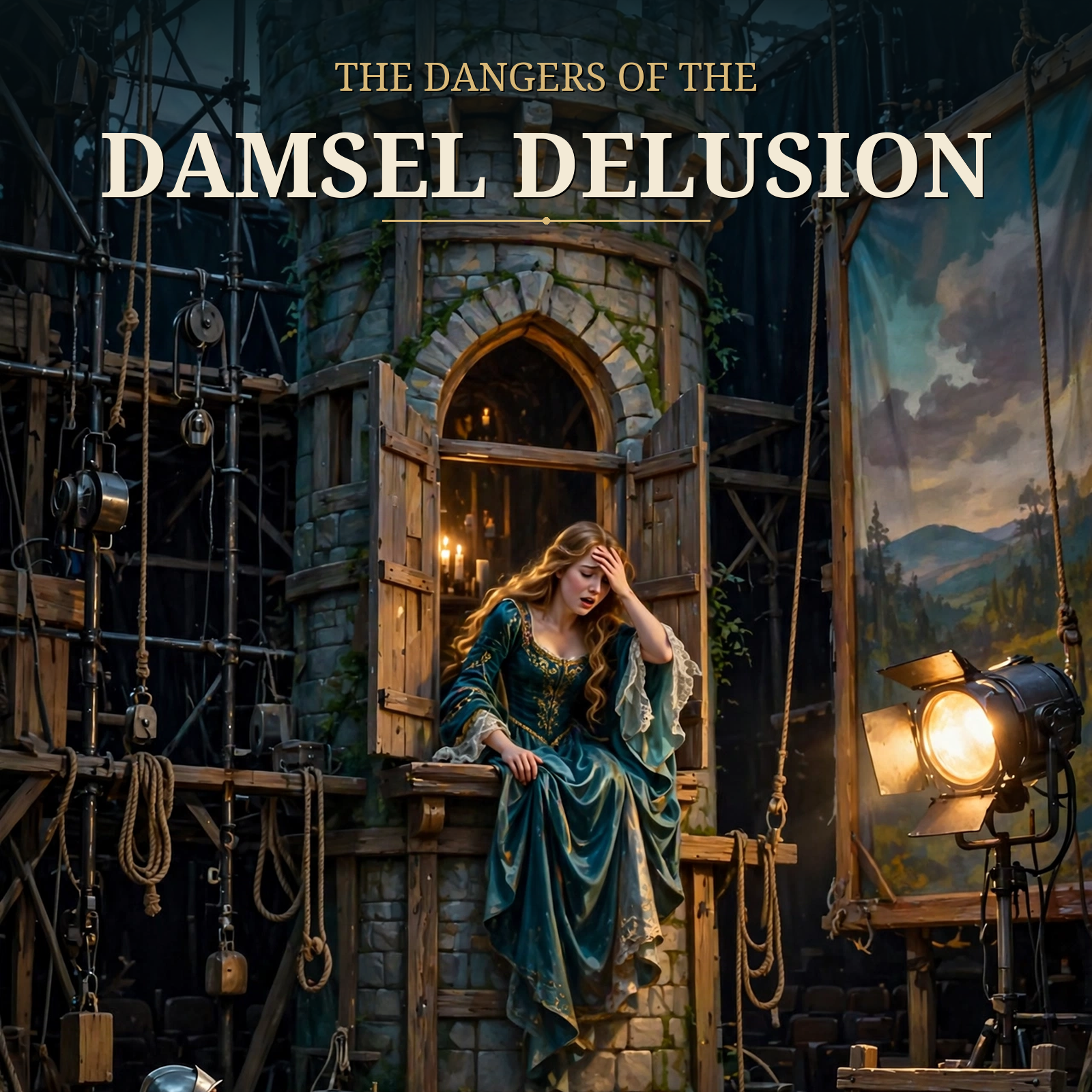
There is a difference between a person in distress and a person performing distress, and if you don't learn to tell them apart, your compassion will be used as a casting couch for somebody else's production.
The damsel delusion is not weakness. It is a casting call.
And get this straight before we go any further: the damsel is not a gender. It's a posture. Women run this production and so do men. The man in permanent victim mode runs the exact same show from a different tower — every ex was crazy, every boss was threatened by him, every door that closed was sabotage — and his distress flare casts the women around him as the Nurse, the Mother, the Savior who will finally make his life work, while any man who stands where he wants to stand becomes the Villain, and the woman who won't play along becomes the Cold One. Same script. Different costume. Psychology has a plainer name for the condition underneath both versions: constant victim mode — the covert narcissist. No crown in sight, and somehow always the wronged one in every story they tell.
Distress goes up like a signal flare, and everyone who answers it gets handed a role before they even know they've auditioned. One person gets cast as the Rescuer — the knight, the nurse, the hero, the one who finally understands them. Somebody else gets cast as the Villain — whoever is standing between them and what they want. And the person whose life they are actually trying to step into gets cast as the Rival — the cold one, the cruel one, the one who just doesn't understand their "connection."
Notice the role that does not exist in the script: the person who sees them clearly and walks away. That part was never written, because the whole production exists to make sure nobody plays it.
Here is the danger to everyone who answers the flare: real distress accepts help. The delusion only accepts installation. Offer a person in the damsel delusion a ladder and watch what they do with it. They don't climb down. They ask why the ladder isn't a throne. Every rescue that doesn't come with the crown, the castle, and somebody else's life attached gets rejected, dramatized, and re-posted as proof that nobody has ever truly been there for them. The help was never the point. The audition was.
And here is the danger to the damsel, and it is the saddest part of the whole pattern: they can never actually be rescued, because rescue would end the show. A delivered damsel has to go home, grow up, and build a life. A performing one has to find a new tower. So the distress must be manufactured fresh forever — new dragon, new villain, same damsel in the window, night after night, year after year, wondering why their life never changes while they turn down every exit that doesn't come with a crown.
Understand what sits underneath it: actually building a life is what they are terrified of. A built life means no victim — and no victim means no rescuer, no caretaker, no audience. Just an adult, responsible for their own days. The whole production exists to avoid that sentence. So they seek validation and someone to take care of them, because left to themselves they cannot sustain it — not for long. And here is the test that proves it: hold them to the standards of the very position they covet. Ask them to do the actual work that throne requires — contribute, reciprocate, carry their share. They cannot function at it. And when you stop carrying what was never yours to carry, you get the temper tantrum: the rage of a little child in a grown body whose caretaker has just clocked out.
The tell is simple, and once you see it you can't unsee it: a person in real trouble reaches for the hand that reaches for them. A person in the delusion reaches past your hand for your life.
So help people. God knows I believe in helping people. But help people — never play roles. When the flare goes up, ask one question before you charge the tower: are they asking to be saved, or are they asking to be installed? The sword of truth cuts that knot in one stroke. It divides soul from spirit, mask from face, performed innocence from fact.
The damsel delusion ends the moment the audience stops auditioning. You don't owe anybody a part in their production — and you were never written into it. God wrote you into your own.
- Jillian Devona Rogers
Written November 5, 2026