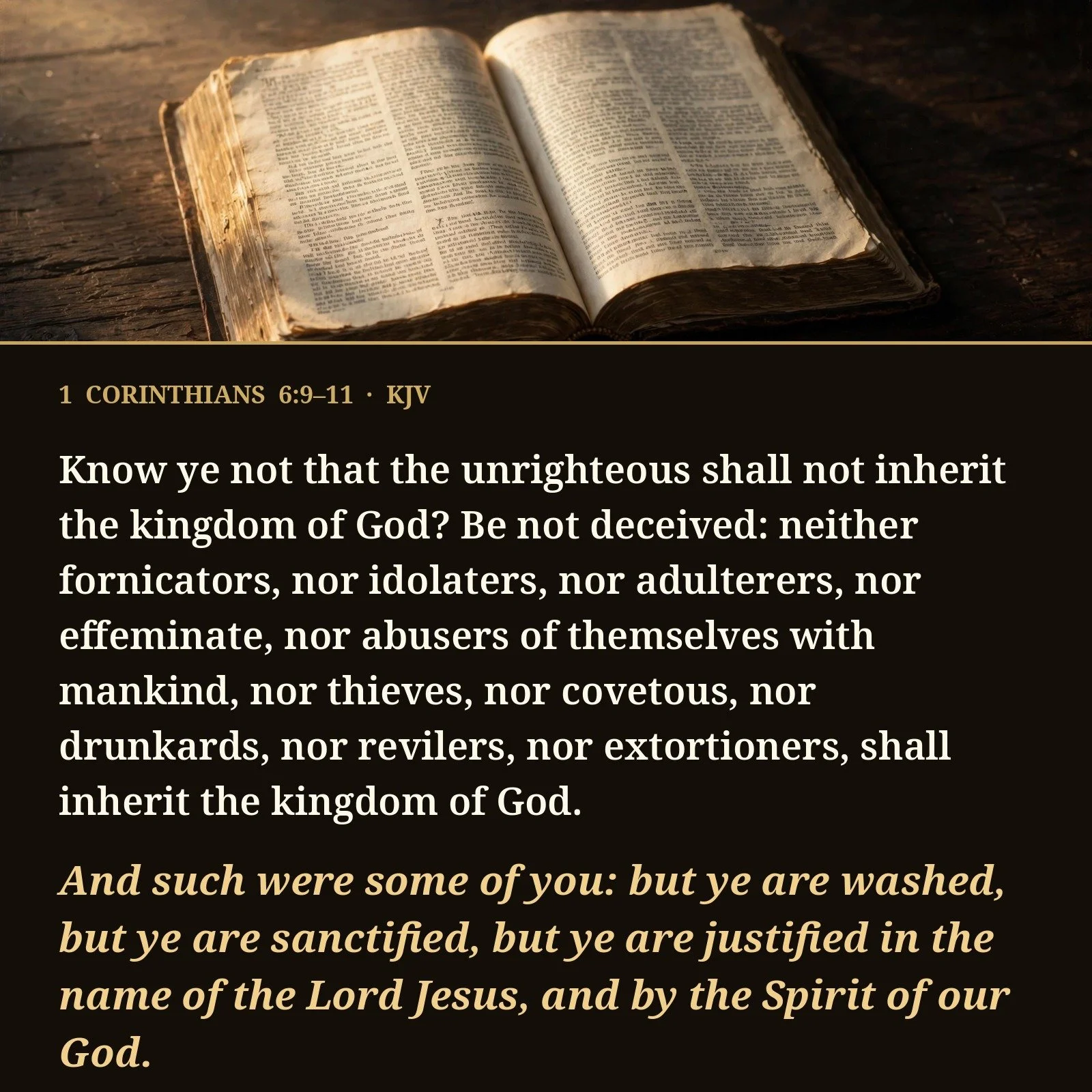
1 Corinthians 6:9–11
Read the list slowly. Sexual sin. Idolatry. Adultery. Thieves. Greed. Drunkards. The abusive. People who cheat people. Paul says none of these will inherit the Kingdom of God — and then he says the sentence most people skip:
"Some of you were once like that."
A word about that list, because translation matters. Paul's Greek names malakoi and arsenokoitai — the old King James renders them "effeminate" and "abusers of themselves with mankind," which is the closest to what was meant, so that's the wording I use. The modern word some translations smuggle in there was never in the text. And understand what the list is actually policing: exploitation, deception, coercion, harm. God doesn't give a shit what you're doing in the bedroom between two CONSENTING ADULTS. Consent is the line. It always has been. Love is Love, period.
Were. Past tense. This verse is not a wall, it's a door — but the door only opens for the ones who actually turn. "But you were cleansed; you were made holy; you were made right with God." Cleansed is not something that happens to you while you keep doing it. It's what happens when you stop, repent, and let the old life die. Nobody can do that dying for you. No one can die for your sins but you — the old you has to go into the ground by your own surrender, or it doesn't go at all.
I know this list from the inside of my own house. My husband was on it. Adultery is on it. Deception is on it. And I watched what it nearly cost him — a body breaking down, a heart failing, a man dying by inches in his own sin. He is not on that list anymore, and not because I dragged him off it and not because anyone covered for him. He repented. He confessed — all of it. He let that man die, and God raised a different one. "Some of you were once like that" is my marriage's testimony in one sentence.
And I know the other side of the verse too — the ones who hear the list and call it an attack. Who rename exposure as a smear campaign. Who proclaim they know better than God's own word and keep every item on the list while wearing a crown they gave themselves. The verse has an answer for that too: "Don't fool yourselves." The Kingdom is not inherited by people who rebrand their sin. It's inherited by the cleansed — and cleansing is not available to the unrepentant, because God will not override a will that refuses to turn. Revoke your consent to the darkness, actually repent, and the door opens. Refuse, and you keep the list.
So don't read this verse as condemnation of your past. Read it as a diagnosis and a promise in the same breath: what you WERE does not have to be what you ARE. But the tense only changes one way — through repentance, through the death of the old self, through the Spirit of our God. Everybody gets offered the past tense. Not everybody takes it.
Our testimony
This is why we can teach the path of redemption: we didn't study it, we walked it. We shed those sins — the adultery, the deception, the double life. Michael repented completely. Not the partial kind, not the kind that keeps a few doors unlocked just in case — completely. He confessed everything, including things he could have taken to his grave unchallenged, and he let the man he was die.
And notice the order, because the order is the teaching: our salvation came AFTER that process, not before it and not instead of it. The cleansing came first. The Kingdom came after. The healing, the restoration, my husband home, this marriage, this life — all of it is on the far side of repentance. God did not bless the sin and call it grace. He waited until the sin was dead, and then He raised something new.
And then there is the one who didn't. Offered the same door, the same verse, the same mercy — and chose the list instead. She is still on it, still unrepentant, still calling her chains a crown, still stuck in a hell entirely of her own creation: hungering, seeking, suffering in a prison of her own mind while telling herself she's the one who was wronged. That is what refusing the past tense looks like from the outside. The door was never locked. She just won't walk through it, because walking through it means admitting what she did — and she would rather keep the hell she knows than surrender the story she tells about it.
Everybody gets offered the past tense. We took it. She didn't. That's the whole difference, and it's the only difference there ever is.
— Jillian Devona Rogers
Written on November 18, 2026